Central
Pacific Railroad Photographic
History Museum
© 2014 CPRR.org. Use of this Web site
constitutes acceptance of the User Agreement which
permits personal use web viewing only; no copying; arbitration; no warranty.
CLICK HERE
for the most current version of this web page.


by
Bruce
C. Cooper
BCC@ThePalaceHotel.org
including
"Souvenir of the Palace Hotel"
An
Illustrated
Booklet with
12 Captioned Photographs as published by
The Palace
Hotel,
San Francisco (c. 1895).
A
Detailed Architectural
Description of
the Palace Hotel from
"Historical
Souvenir of San
Francisco, Cal."
as published by
C.P. Heininger, San Francisco
(1887).
A
Booklet for
Guests and
Rate Card
published by the new
Palace Hotel, San Francisco (1922).
A total of more than
~ 125 ~
Period
& Original Modern Photographs,
Images, and Illustrations.


 Opened
on October 2, 1875, the original Palace
Hotel was
the glorious final
"gift" of the colorful -- but ill-fated -- William
Chapman Ralston to his adopted home city of San Francisco.
Born in
Ohio on January 12, 1826, Ralston, an agent -- and sometimes even last
minute captain
-- of Gold
Rush
steamers that
ferried thousands of gold-seekers to California from Panama, was 28
when
he finally settled himself in the still wild young city by the Bay in
1854.
By the time he co-founded the Bank
of California there a decade later in 1864, the
energetic and innovative
Ralston was already on his way to becoming one of the city's -- and the
West's -- wealthiest
and most important men. The same year that he opened the bank, Ralston
also began building
a magnificent summer home called "Ralston
Hall" on his recently purchased 14-acre
estate named "Belmont"
located twenty-five miles south of the city. (The magnificent
four-story,
eighty-room, 55,360 square foot mansion
that resulted still stands there today as a glorious example of this
golden era.) Many of Ralston Hall's
magnificent
architectural features such as its stately dining room, a 28' x 61'
mirrored
"Versailles"
ballroom, an "opera
box" gallery encircling the grand staircase leading to the
second floor
modeled after the Paris
Opera House, and the classic columns and crystal chandeliers
in its
foyer all presaged the design of similar features incorporated into the
design of the Palace Hotel a
decade later.
Opened
on October 2, 1875, the original Palace
Hotel was
the glorious final
"gift" of the colorful -- but ill-fated -- William
Chapman Ralston to his adopted home city of San Francisco.
Born in
Ohio on January 12, 1826, Ralston, an agent -- and sometimes even last
minute captain
-- of Gold
Rush
steamers that
ferried thousands of gold-seekers to California from Panama, was 28
when
he finally settled himself in the still wild young city by the Bay in
1854.
By the time he co-founded the Bank
of California there a decade later in 1864, the
energetic and innovative
Ralston was already on his way to becoming one of the city's -- and the
West's -- wealthiest
and most important men. The same year that he opened the bank, Ralston
also began building
a magnificent summer home called "Ralston
Hall" on his recently purchased 14-acre
estate named "Belmont"
located twenty-five miles south of the city. (The magnificent
four-story,
eighty-room, 55,360 square foot mansion
that resulted still stands there today as a glorious example of this
golden era.) Many of Ralston Hall's
magnificent
architectural features such as its stately dining room, a 28' x 61'
mirrored
"Versailles"
ballroom, an "opera
box" gallery encircling the grand staircase leading to the
second floor
modeled after the Paris
Opera House, and the classic columns and crystal chandeliers
in its
foyer all presaged the design of similar features incorporated into the
design of the Palace Hotel a
decade later.
 As
with the buildings themselves,
Ralston spared no expense
in the sumptuous furnishing and decorating of the mansion, guest
quarters,
and stables at Belmont. "Books and paintings were sometimes bought
wholesale,"
notes Amelia
Ransome Neville
in "The
Fantastic
City -Memoirs of the Social and Romantic Life of Old San
Francisco."
"When he was furnishing Belmont, he called one day at the studio of Thomas
Hill where the walls were covered with the artist's
paintings. Mr.
Ralston glanced about. 'How much for the lot?' he asked. A generous
price
was paid and Hill's landscapes were hung all over Belmont." [In 1881, Hill
completed his most famous and ambitious work, "The
Last Spike," depicting the joining
of the Central Pacific and Union Pacific Railroads at Promontory
Summit,
U.T., on May 10, 1969, and published a booklet
about the massive work at the same time.]
As
with the buildings themselves,
Ralston spared no expense
in the sumptuous furnishing and decorating of the mansion, guest
quarters,
and stables at Belmont. "Books and paintings were sometimes bought
wholesale,"
notes Amelia
Ransome Neville
in "The
Fantastic
City -Memoirs of the Social and Romantic Life of Old San
Francisco."
"When he was furnishing Belmont, he called one day at the studio of Thomas
Hill where the walls were covered with the artist's
paintings. Mr.
Ralston glanced about. 'How much for the lot?' he asked. A generous
price
was paid and Hill's landscapes were hung all over Belmont." [In 1881, Hill
completed his most famous and ambitious work, "The
Last Spike," depicting the joining
of the Central Pacific and Union Pacific Railroads at Promontory
Summit,
U.T., on May 10, 1969, and published a booklet
about the massive work at the same time.]
After
twenty years in San Francisco building his fame and fortune, however,
by
the summer of 1875 W.C. Ralston's highly leveraged empire had fallen
into
deep financial peril. He was finally wiped out completely when the Bank
of California collapsed after its depositors and other investors
panicked
as the result of a mining
stock fraud involving what proved to be mostly worthless
mines along
and near the grades of the Central Pacific, Union Pacific, and Virginia
& Truckee Railroads. After a $1,400,000 one day run
on the Bank,
its directors called in Ralston, who by then was President of the Bank,
on August 27, 1875, and forced him to relinquish control of his
institution.
Although Ralston was said to have taken the news with equanimity, just
hours later the 49-year old entrepreneur's body was found floating in
San
Francisco Bay just off Meigg's
Wharf. Although he swam in the Bay there almost daily, the
events of
a few hours earlier left many suspecting that Ralston's death was a
suicide
by drowning. However an autopsy and Coroner's inquest -- on which
depended
the payment of life insurance to Ralston's widow and their four
children
-- ruled that he had not drowned as a suicide, but instead died of an
"apoplectic
stroke."
A reported 50,000 San Franciscans lined the streets of the city for
miles
to watch the passage of his lavish funeral cortege from Union Square.


The
"Original" Palace Hotel
1875
 In
what proved to be his final dream
project for his adopted
city, William Ralston had wanted to turn 1870's San Francisco from a
still
young Pacific boom town into a world class metropolis by erecting a
grand
hotel of timeless elegance and unprecedented luxury. To that end
Ralston
had commissioned Irish-born architect and engineer John Painter Gaynor
(who had worked earlier on Ralston Hall) to study Europe's finest
hotels
for
ideas. Ralston intended, of course, that these Continental hotels would
soon all pale in comparison to his new Palace Hotel which began to rise
in early 1873 on a two-and-a-half acre site on the SW corner of Market
and
New
Montgomery Streets across from the existing four story "gingerbread" Grand Hotel, an earlier Ralston project
located at the intersection's SE corner. Previously occupied by a large
sandhill, Ralston
had acquired the 375 x 250 foot rectangular property in pieces for a
total of $400,000.
In
what proved to be his final dream
project for his adopted
city, William Ralston had wanted to turn 1870's San Francisco from a
still
young Pacific boom town into a world class metropolis by erecting a
grand
hotel of timeless elegance and unprecedented luxury. To that end
Ralston
had commissioned Irish-born architect and engineer John Painter Gaynor
(who had worked earlier on Ralston Hall) to study Europe's finest
hotels
for
ideas. Ralston intended, of course, that these Continental hotels would
soon all pale in comparison to his new Palace Hotel which began to rise
in early 1873 on a two-and-a-half acre site on the SW corner of Market
and
New
Montgomery Streets across from the existing four story "gingerbread" Grand Hotel, an earlier Ralston project
located at the intersection's SE corner. Previously occupied by a large
sandhill, Ralston
had acquired the 375 x 250 foot rectangular property in pieces for a
total of $400,000.
 While
Ralston had depended
heavily on his shaky banking
empire to help finance his $5 million dream, the sudden collapse of his
Bank of California in late August -- and Ralston's shocking and
unexpected
death on the same day that he lost control of the institution -- did
not
interfere with the opening of the Palace Hotel two months later.
Ralston's
business partner
U.S.
Senator William Sharon -- who had helped cause the collapse
of the
Bank when he dumped his stock in the Comstock
Lode -- ended up in control of both the Bank and Ralston's
debts (both
of which which he paid off at just pennies on the Dollar), and as well
as the then almost completed Palace Hotel. Personally, Sen. Sharon also
took over Ralston Hall by paying the late banker's widow just $50,000
for
the multi-million Dollar estate, and lived there until his death in
1885.
While
Ralston had depended
heavily on his shaky banking
empire to help finance his $5 million dream, the sudden collapse of his
Bank of California in late August -- and Ralston's shocking and
unexpected
death on the same day that he lost control of the institution -- did
not
interfere with the opening of the Palace Hotel two months later.
Ralston's
business partner
U.S.
Senator William Sharon -- who had helped cause the collapse
of the
Bank when he dumped his stock in the Comstock
Lode -- ended up in control of both the Bank and Ralston's
debts (both
of which which he paid off at just pennies on the Dollar), and as well
as the then almost completed Palace Hotel. Personally, Sen. Sharon also
took over Ralston Hall by paying the late banker's widow just $50,000
for
the multi-million Dollar estate, and lived there until his death in
1885.
After
four years of contruction
-- and two months after Ralston's
untimely death -- his magnificent new Palace Hotel finally opened its
doors on
October
2nd, 1875, to wild acclaim and with great fanfare. (Ironically the
refinanced
Bank of California also reopened on the same day.) Soon known popularly
as the "Bonanza Inn",
for the next three
decades
the Palace Hotel would serve as a fitting monument to the dreams and
imagination
of William C. Ralston, the "Magician of San Francisco."
As
promised, San Francisco's newest landmark was stunning in its design
and
innovation. The skylighted open center of the building featured a Grand
Court -- overlooked by seven stories of white columned
balconies --
which served as an elegant carriage entrance for a parade of the rich
and
famous visiting San Francisco, and from which these already awed guests
entered the hotel's magnificent lobby
to check in.
[Shortly after 1900 the Grand Court was converted a lounge called the
"Palm Court."] The
hotel's
redwood paneled hydraulic elevators -- known as "rising rooms" --
allowed
its guests to easily reach any of the hotel's seven
floors.
Each guest room or suite was
equipped with an electronic
call button to summon a member of the hotel's large and attentive staff
who were always ready to attend to each guest's every whim. All 755
guest
rooms (each with a private bathroom) could be
easily
joined together to create suites, or to make up large apartments for
long
term residents. The parlor of each guest room also featured a large bay
window overlooking the street below.

The Grand Court is seen here in 1904 after it had been
converted
from the Palace Hotel's carriage entrance to a gracious central lounge.
Among
the Palace Hotel's public
rooms were the white and
gold American Dining Room,
located right off the main
lobby, which could accommodate over 600. There were also two elegant
"Grille
Rooms" -- one for Ladies, and
another for Gentlemen.
The Maple Hall was available
for receptions, while
the Tapestry Room accommodated
private dinners. Three
"Louis
Quinze" style "Parlors"
(which could be combined
into a single large room) were also available for public and private
functions.
A Colonial style Billiards Room
provided a place
for gentlemen guests to relax, as did the magnificently appointed Bar.
For
the next three decades, the
Palace Hotel was the City's
symbol of world class elegance to both visitors and San Franciscans
alike.
(Among the many important events to take place there were a series of
hearings
before the U.S. Pacific Railway Commission
in the summer
of 1887 at which Lewis
M. Clement was among those to provide testimony.)
This all changed, of course, just after 5:12 A.M. on Wednesday, April
18, 1906,
when a massive earthquake
shook all of the San Francisco Bay Area. While the deliberately
overbuilt and presumably "fireproof" Palace Hotel
survived
the quake with relatively modest physical damage, like so many other
important buildings in the city, the
hotel
was soon overtaken by the raging fires that followed in its wake over
the next
three days. The flames reached the hotel early Wednesday afternoon, and
by nightfall the magnificent world famous structure was reduced to a
burned
out shell.
 |
 |
| By 2:30pm, flames had invaded
the "fireproof" Palace Hotel ... |
... and within hours they left
the Palace an empty, burned out shell. |
The "Baby" Palace Hotel
1906
 As the scorched shell of the Palace
began to be razed, a
modest 23-room "temporary" Palace Hotel (often called
the "Little" or "Baby" Palace
Hotel) arose eight blocks west of the Market Street site at
the NW
corner of Post and Leavenworth Streets which opened to the public with
considerable fanfare on November 17, 1906. Just
five months after its debut, however, the Palace Hotel Company
announced on
April 24, 1907, that it had signed a ten-year lease for the Fairmont
Hotel on Nob Hill and that the Baby Palace would therefore soon be
closed.
As the scorched shell of the Palace
began to be razed, a
modest 23-room "temporary" Palace Hotel (often called
the "Little" or "Baby" Palace
Hotel) arose eight blocks west of the Market Street site at
the NW
corner of Post and Leavenworth Streets which opened to the public with
considerable fanfare on November 17, 1906. Just
five months after its debut, however, the Palace Hotel Company
announced on
April 24, 1907, that it had signed a ten-year lease for the Fairmont
Hotel on Nob Hill and that the Baby Palace would therefore soon be
closed.  On July 16th, the 2,927th and last
guest checked out of the Baby Palace just 251 days
after it had opened and the building was promptly turned over to The
Olympic Club,
a private athletic club founded in 1860 which had leased the two-story
frame structure for a
period of five years. The OC quickly converted the former
hotel into a
temporary
clubhouse for its members to use while its own then fire
gutted
1893 vintage facility
located
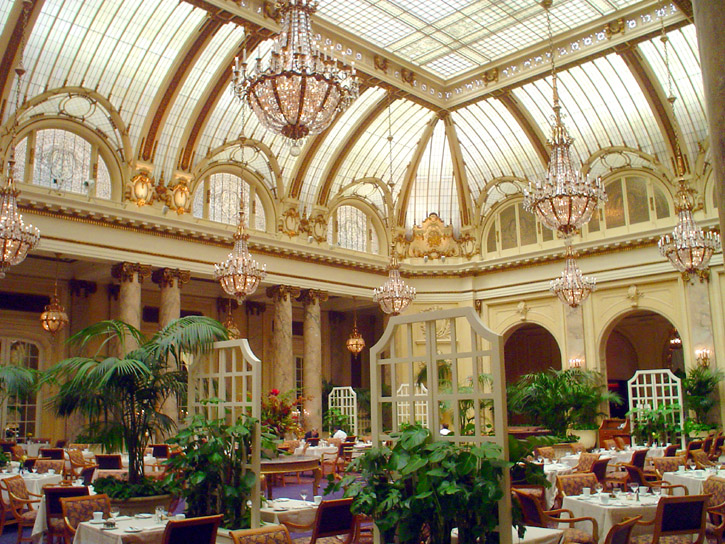
two-and-a-half blocks to the east at 524 Post Street was
being rebuilt.
(The Olympic Club moved into the new clubhouse in June, 1912, and still
occupies that massive brick building today.) By 1916 the Baby
Palace's building was gone and had been
replaced
at the NW corner of Post & Leavenworth by a four story brick apartment house
which still stands there now almost a century later. For many years,
the ground level of that structure has been occupied along its Post
Street side
by the popular "Cafe
Royale" resturant and wine bar.
On July 16th, the 2,927th and last
guest checked out of the Baby Palace just 251 days
after it had opened and the building was promptly turned over to The
Olympic Club,
a private athletic club founded in 1860 which had leased the two-story
frame structure for a
period of five years. The OC quickly converted the former
hotel into a
temporary
clubhouse for its members to use while its own then fire
gutted
1893 vintage facility
located
two-and-a-half blocks to the east at 524 Post Street was
being rebuilt.
(The Olympic Club moved into the new clubhouse in June, 1912, and still
occupies that massive brick building today.) By 1916 the Baby
Palace's building was gone and had been
replaced
at the NW corner of Post & Leavenworth by a four story brick apartment house
which still stands there now almost a century later. For many years,
the ground level of that structure has been occupied along its Post
Street side
by the popular "Cafe
Royale" resturant and wine bar.
The "New" Palace Hotel
1909
 Forty-three months after the
destruction of the original Palace, a
nine story "new"
Palace Hotel opened
its doors on December 19, 1909, at the Market and new Montgomery
Street site.
While
much plainer on the outside, for over a
century
now the new Palace Hotel has been as elegant, sumptuous, and gracious
on
the inside as was its famous predecessor. The "Palm
Court" (also
called the "Garden Court") -- which occupies the same area as the Grand
Court did in the original hotel -- has been San Francisco's most
prestigious
hotel dining room since the day it opened in 1909. Almost anybody who
is
anybody has quenched their thirst at one time or another in the "Pied
Piper" Bar (overseen by its famous Maxfield
Parrish painting) which is located just off the gleaming
polished marble
lobby.
Forty-three months after the
destruction of the original Palace, a
nine story "new"
Palace Hotel opened
its doors on December 19, 1909, at the Market and new Montgomery
Street site.
While
much plainer on the outside, for over a
century
now the new Palace Hotel has been as elegant, sumptuous, and gracious
on
the inside as was its famous predecessor. The "Palm
Court" (also
called the "Garden Court") -- which occupies the same area as the Grand
Court did in the original hotel -- has been San Francisco's most
prestigious
hotel dining room since the day it opened in 1909. Almost anybody who
is
anybody has quenched their thirst at one time or another in the "Pied
Piper" Bar (overseen by its famous Maxfield
Parrish painting) which is located just off the gleaming
polished marble
lobby.
 As with the
original hotel, "everybody who is anybody" stayed at the Palace when
they visited San Francisco including captains of industry, famous
entertainers, international royalty, and politicians of every stripe
including many Presidents of the United States. What would prove to be
the most famous visit of one of the nation's chief executives came on
July 31, 1923, when 58-year old President Warren G. Harding and his
wife, Florence, checked in to the Presidential Suite (Room 8064)
at the Palace. The Hardings were returning to Washington, DC, after a
visit to Alaska and stopped in San Francisco where he was scheduled to
deliver a speech to the World Court although that event was cancelled
because he was
feeling quite unwell when he arrived in the city by train. By the
afternoon
of August 2nd, however, the President seemed to be recovering and was
sitting up in bed at the Palace with Mrs. Harding reading the newspaper
to him when he suddenly suffered a seizure and died about 7:30 in the
evening. The cause of death still remains a controversial, but was said
at the time to be a stroke or "apoplexy".
As with the
original hotel, "everybody who is anybody" stayed at the Palace when
they visited San Francisco including captains of industry, famous
entertainers, international royalty, and politicians of every stripe
including many Presidents of the United States. What would prove to be
the most famous visit of one of the nation's chief executives came on
July 31, 1923, when 58-year old President Warren G. Harding and his
wife, Florence, checked in to the Presidential Suite (Room 8064)
at the Palace. The Hardings were returning to Washington, DC, after a
visit to Alaska and stopped in San Francisco where he was scheduled to
deliver a speech to the World Court although that event was cancelled
because he was
feeling quite unwell when he arrived in the city by train. By the
afternoon
of August 2nd, however, the President seemed to be recovering and was
sitting up in bed at the Palace with Mrs. Harding reading the newspaper
to him when he suddenly suffered a seizure and died about 7:30 in the
evening. The cause of death still remains a controversial, but was said
at the time to be a stroke or "apoplexy".

Engraved "End of the Trail" vignette from 1920's
Palace Hotel
letterhead.
(Click
on the
above image to see a high resolution version this vignette.)
The
"Renovated" Palace Hotel
1991
 By
the late
1980's the "new" Palace was closing in on eight decades of hard service
and it was beginning to show. It order to bring the great lady of
Market Street back to its place of glory, the owners decided that the
best course was close it down for for a complete
top-to-bottom restoration which got underway
in early January, 1989. Ironically ten months into the process, San
Francisco and the Bay area experienced
its first major seismic event since 1906 when a group of strong 6.7
- 7.1 temblors centered in Loma Prieta just south of the city
rocked
the entire Bay area starting at just a little after 5 in the afternoon on
October 18, 1989.
This time the quakes did considerable stuctural damage to the Palace
which halted the restoration for a time so that new engineering plans
could be developed which included a major seismic retrofit. The Palace
remained closed for
another year-and-a-half, but when the its doors were finally reopened
to
the public on April 3, 1991, and guests checked in for the first time
in 27 months, it proved to be well worth the effort. The hundreds of
thousands of
man hours of careful work applied to every inch of the great structure
had
restored to its 1909 glory at a cost of more than $150 Million. And
with that,
the renewed
"new" Palace Hotel was ready to again serve San Francisco as
its greatest
hostelry for many, many more decades to come.
By
the late
1980's the "new" Palace was closing in on eight decades of hard service
and it was beginning to show. It order to bring the great lady of
Market Street back to its place of glory, the owners decided that the
best course was close it down for for a complete
top-to-bottom restoration which got underway
in early January, 1989. Ironically ten months into the process, San
Francisco and the Bay area experienced
its first major seismic event since 1906 when a group of strong 6.7
- 7.1 temblors centered in Loma Prieta just south of the city
rocked
the entire Bay area starting at just a little after 5 in the afternoon on
October 18, 1989.
This time the quakes did considerable stuctural damage to the Palace
which halted the restoration for a time so that new engineering plans
could be developed which included a major seismic retrofit. The Palace
remained closed for
another year-and-a-half, but when the its doors were finally reopened
to
the public on April 3, 1991, and guests checked in for the first time
in 27 months, it proved to be well worth the effort. The hundreds of
thousands of
man hours of careful work applied to every inch of the great structure
had
restored to its 1909 glory at a cost of more than $150 Million. And
with that,
the renewed
"new" Palace Hotel was ready to again serve San Francisco as
its greatest
hostelry for many, many more decades to come.
[NOTE:
The United States Pacific
Railway Commission was created by an act of Congress of March
3, 1887
(24 Stat. 488). This act authorized the President to appoint three
commissioners
to investigate the affairs of those Pacific railroads that had received
aid from the Federal Government. On April 15, 1887, President Grover
Cleveland
appointed the Commission, composed of Robert E. Pattison, chairman; E.
Ellery Anderson; and David T. Littler. The main office was established
in New York; temporary offices were located in San Francisco and
Washington.
The scope of the Commission's investigation "included a history of
these
roads, their relations and indebtedness to the Government, and the
question
whether in the interest of the United States an extension of the time
for
the performance of the obligations of said roads to the Government
should
be granted; and, if so, the . . . Commissioners were directed to submit
a scheme for such an extension." The Commissioners reported to the
President
on December 1, 1887. Anderson and Littler concurred in the report of
the
Commission, while Pattison presented a dissenting report. The majority
report recommended an extension of time for the payment of the debts of
the railroads to the Government, while the minority report recommended
that proceedings be instituted for forfeiting the charters of the
railroads
and for winding up their affairs. The findings of the Commission were
transmitted
to Congress by President Cleveland on January 17, 1888.]

Palace Hotel "End of the
Trail" PPC. In the 1920's
an engraved
version
of this image (see above) was used as the vignette on the Palace Hotel
letterhead.
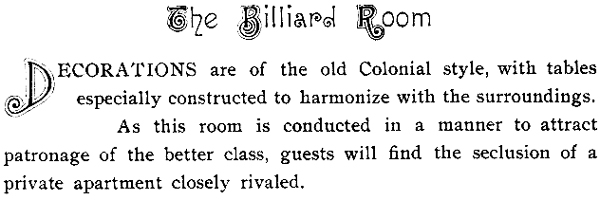
"Souvenir of the Palace Hotel"
An
Illustrated Booklet with
12 Captioned Photographs as published by
The Palace
Hotel,
San Francisco (c. 1895).




|
|
|

The following three articles all appeared in the October 9, 1875 issue Frank Leslie's Illustrated Newspaper
published just a week after The Palace Hotel opened in San Francisco on October 2, 1875.
OUR PALACE HOTELS.
IN
another place in this paper we give a double-page picture of the famous
Palace Hotel which has just been completed at San Francisco.
Accompanying the picture will be found a detailed description of the
immense edifice and of ail its interior arrangements—a
description at once minute and exhaustive, and sufficient to enable the
ordinary reader to form a clear conception of the vastness, as well as
the comforts and conveniences, of the greatest hotel ever built, in
ancient or modern times, for the accommodation of the general public.
Buildings as large have been reared and do exist, but for hotel
purposes no edifice of the same dimensions was ever contemplated and
brought to completion. The Palace Hotel is a natural outcropping of
American life and habit. It would not have been thought of. it could
not have been built, by any other people, or in any other land. The
Union and other hotels at Saratoga have long been objects of
astonishment to strangers ; but these are now completely put in the
shade, dwarfed and rendered insignificant; and the Palace Hotel at San
Francisco must be pronounced one of the wonders of modern times.
The hotel on a large scale has long been a
peculiarly American institution. In it our people seek and find a
suitable and congenial home. It was, at one time, thought that the
taste for hotel life would diminish as the Republic advanced in years,
as wealth increased, and as the people settled down in established
centres of commerce, trade and industry. Facts, however, do not favor
this expectation. Hotels in ever increasing size multiply : and the
natural inference is that the taste for hotel life is not only not
diminishing, but rather growing with our growth and increasing with our
strength.
One wonders, sometimes, why it should be so. It is
not denied that the hotel has many special advantages. It secures much
of the comfort of home, properly so called, without the cost and care
and responsibility which are inseparable from the setting up and
maintenance of a separate domestic establishment. It is, moreover,
singularly adapted to the genius of the American people, among whom
distinctions of class, however much coveted by some, are frowned down
by the many. An American hotel, with its public dining room and parlors
and its various other common conveniences, is a miniature
representative of the Republic. At the hotel, one man is as good as
another ; and if only he is possessed of the requisite quantity of
stamps, Jack calls no man his master. The daughter of the peasant is on
a footing of perfect equality with that of the President; and the
tradesman's son, equally with the scion of the proudest family in the
land is permitted to enjoy in advance the honors and privileges of the
sovereign citizenship of the Republic. At the same time it would be
absurd to deny that hotel life has its drawbacks as well as its
advantages. It is wanting in many of the higher elements and more
endearing qualities of home in the good old-fashioned sense of the
word. In the larger and more easy relationship begotten of the
promiscuous crowd, the ties of the family circle become loosened. The
family in fact, as such, with all its sweet endearments and hallowed
joys, practically ceases to exist. Such scenes as those which Burns has
made immortal in his "Cotter's Saturday Night" can scarcely be
conceived in connection with the loose, promiscuous and irresponsible
life of an American monster hotel. And most certainly it was not of
hotel life that Howard Payne was thinking when he penned that sweetest
of songs, "Home Sweet Home!" How much that is sweet in life and
literature conies from attachment to particular scenes, and from
associations therewith connected ; and how much of true patriotism in
every age of the world lies sprung from the sacred love of home in the
strictest and narrowest sense! Then again, how much of that true
affection which binds families together, making the interest of each
the interest of all, is due to the close personal intercourse and
minute observation possible only in the private home circle; and how
much home example and home experience tend to the development of those
virtues and graces which adorn the individual character, and which
prove the best safeguard of the nation's weal! To the development of
those healthful sentiments and to the cultivation of those virtues and
graces it cannot be said that hotel life, as known among us, is in the
highest degree favorable.
We have no desire to disesteem establishments which,
for the present at least, and at some points, seem to be indispensable,
or to discourage enterprises which are intended for the comfort and
convenience of the public ; but we cannot let go the opportunity of
saying that if the money which is annually spent by our wealthier
classes in hotels at the various Summer retreats were spent in building
and maintaining rural villas, suitable for the. accommodation of single
families, the result would be an increase of family comfort and a
positive gain to the community at large. Saratoga would not the less be
Saratoga, but, perhaps, rather the more, if her vast Summer population
found accommodation in smiling villas on the sides of her beautiful
hills or by the sparkling waters of her lovely lake.
As hotels are still a necessity, and as there is
still a disposition to build them on a gigantic scale, it is gratifying
to find that in this latest and grandest enterprise of the kind at San
Francisco everything has been done to add to the comfort and to provide
for the safety of the guests. In buildings so large, where thousands of
people may be gathered together, and even sleeping under the same roof,
fire is the monster most to be dreaded. At the Palace Hotel, fire, it
would seem, is rendered all but impossible. This is well. Altogether,
the Palace Hotel is worthy of San Francisco—a city which is
destined to be the golden gate of communication between Asia on the one
hand and America and Europe on the other.
\
THE GREAT CARAVANSARY OF THE WESTERN WORLD.
The Palace Hotel, San Francisco.
CALIFORNIA, the land
of prodigies, of giant trees, of mighty mountains, of wonderful
vegetable growth, of stupendous enterprises, and of colossal schemes,
comes forward once again to claim a championship. She throws down the
gauntlet to her older sister States and challenges them to equal her in
the matter of hotel accommodations. New York, Saratoga, Chicago and St.
Louis has each claimed the palm of excellence for its own magnificent
caravansaries, but San Francisco with her Palace Hotel can confidently
boast of having the finest hotel building in the country, and one that
in all the features of excellence and completeness probably surpasses
any similar edifice in the world.
The Palace Hotel was projected by the late William
C. Ralston and the Hon. William Sharon, who with their usual energy and
public spirit it determined to furnish the city of San Francisco with a
hotel which should challenge the world. In pursuance of this intention,
Messrs. Ralston and Sharon selected the well-known architect, J. P.
Gaynor, to visit the principal cities of the United States and Europe,
for the purpose of thoroughly examining the most celebrated hotels of
the world before preparing his plans and specifications. He was to
include in the plans of the Palace all existing improvements, and such
additional ones as his experience and observation might suggest. The
projectors were also determined that the hotel when completed should be
under the management of the most competent man in America, and were
fortunate in not only obtaining Mr. Warren Leland as lessee, but also
in securing his services in superintending the work of construction.
Mr. Leland's aid to the architect has been invaluable, as in the
running of a hotel after it is completed, so in the knowledge of how it
should be built, he excels. He is master of the subject in its largest
generalities and its smallest details.
The erection of the building was begun over a year
ago, and was finished a short time since. It how stands one of the most
beautiful architectural edifices in the city of San Francisco. Striking
as is the vastness of the building when viewed from a point near at
hand, to get a true idea of its comparative size one must see it from
the Bay, east of the city. Viewed from that standpoint, it is the most
conspicuous object in the view, and looming up above the sea of houses,
presents a grand and imposing appearance.
 Click on the above image to see a high resolution (300dpi, 22MB) version of this engraving.
(NOTE: This is a "progressive" jpg sent in three scans which will show greater
Click on the above image to see a high resolution (300dpi, 22MB) version of this engraving.
(NOTE: This is a "progressive" jpg sent in three scans which will show greater
detail as each part is downloaded so be patient to get the full effect.)
The new hotel occupies the land bounded by New
Montgomery, Market, Annie and Jessie Streets, having frontages as
follows: On New Montgomery, 850 feet; Market, 275 feet; Annie, 350
feet, and Jessie 275 feet, covering a space of 96,250 feet. To enable
the reader to compare its size with that of other monster hotels, it
may be stated that the Grand Pacific Hotel, Chicago, covers but 58,145
square feet. The Grand Hotel in Paris has only 720 rooms, while the
Palace Hotel of San Francisco has 755 rooms above the ground-floor
exclusively for the use of guests.
The building is seven stories in height. It is most
substantially built, and is fireproof in all essential points. The
lower story is 25 feet high ; the others 14 and 16 feet. Long rows of
bay windows, piled one above another, extend from the top of the first
story to the roof. The brick walls are covered with cement painted a
clear white. Between the bay windows are seen the gilded washers or
anchor-heads of the iron bars used for strengthening the building,
which give a pleasant relief to the pure white sea of wall and windows.
The building has the strength of a fortress. At the
base all the foundation-walls are built with inverted arches, and are
twelve feet thick. Every wall in the building, exterior, interior or
partition, has iron bars running through it from one end to the other,
the bars at each end being secured by iron washers or anchor-heads. In
the lower stories these bars are five feet apart. In the upper stories
they are placed nearer together, and in the topmost story they are only
two feet apart. It by any chemical process every portion of the
building except the iron could be suddenly eaten away, and the bars be
left in their present position, we should see a gigantic network of
iron bars crossing each other at right angles, and so thick together
that we could with ease trace the lines formerly occupied by the
thousands of partition-walls. The cement coating on the outside of the
brick walls also adds to the strength of the building, for it will
become as hard as stone, harder indeed, than the brick. The
construction of the building has required 24,661,000 hard bricks,
28,398 barrels of cement and 22,160 barrels of lime.
It is estimated that the total cost of the building
will be: Ground, $1,000,000 ; building, $1.7,30,000; furniture,
$500,000; total, say about $3,250,000. The basement throughout is to be
10 feet in the clear. In it are the following rooms : Wine-room, 55 x
42 ; china and glass-room, 21 x 55 ; mechanics' dining-room, 21 x 55 ;
pantry, 21 x 55 ; servants' dining-rooms, each 21 x 55 ; baggage-room,
55 x 21; linen-room, 41 feet square ; airing-room, 20 x 40 ;
drying-room, 40 feet square; wash-room, 40 feet square, and other
apartments too numerous to mention. This is a most extraordinary
disposition of space, and is an indication of the gigantic nature of
the whole affair.
The first or ground story presents the main entrance
on New Montgomery Street, with a driveway 20 feet wide ; with sidewalks
10 feet in width: the latter of white marble and the driveway of
asphaltum. There are three inner courts, the central one being 144 x
84, which is covered with glass, on a level with the roof of the
building. On New Montgomery Street 160 feet are used for hotel
purposes, in addition to the driveway. The rest of the New Montgomery
Street front, and also the Market Street ironware intended for stores
that have a double frontage, one on the street and the other at the
arcades in the rear and within the hotel. The central court has a
circular driveway of 18 feet, a marble-tiled promenade, and a tropical
garden filled with exotic plants, statuary and fountains. It is
surrounded on all sides with arcaded galleries on every floor, each
twelve feet wide, and forming in itself a continuous promenade. To the
right of the main entrance is situated the ladies' door, giving
entrance to the Ladies' Reception Room,- 40 feet square. Also two rooms
devoted to the' use of the ladies, 15 x 20. $ti the left is the door
leading to the reception room for gentlemen, 40 feet square ; also two
small rooms, each 15 x 20. On this floor is the office, 55x65; coat and
baggage-room, 20 feet square, and two small private dining rooms, each
20 feet square. Breakfast-room, 110 x 55 : ball-room, 64 x55 ;
dining-room, 150 x55 : kitchen and pantry, 84x50; space for
working-room, servants' stairs, coal and ash-sheds, elevator for
service of house, lock-up and pantries, 84x22. Barber-shop, 20x40 ;
wash-room, 20x40; public water-closets, 40 feet square; bar-room, 40
feet square; billiard-room, 40 x 60 i four committee-rooms, each 20
feet square. At the rear end of the Courts on this floor, is a
magnificent staircase occupying a space 60x30. This story is 27 feet in
the clear, except over the stores, where there is an entresol or
intermediate story. There are five elevators for the use of the guests
and passengers, worked by water, thus affording rapid, easy and safe
transit up and down. In addition there are seven other broad stairways,
conveniently located for the ingress and egress to and from all parts
of the building.
The second story is divided up entirely into suites
of rooms, except rooms for parlors, private dining- rooms, rooms set
aside for private entertainment for guests, or for outside parties, as
is the case at the Grand Hotel, Paris. The main parlor is 40 feet
square, and one on each side 20x40. The house is so constructed that
each suite of rooms will be as much withdrawn as if they were in a
private house, and are furnished with every Convenience" as to bath
rooms, closets, etc. On this floor is also the children and nurses'
dining-room, 40 feet square; dining-room for officers of the hotel,
20x40, and ladies' billiard-room, 40 feet square. There are on this
floor 138 rooms, one-half 20 feet square, and none less than 16 feet
square—15 feet ceilings. Each room has a fireplace; and all the
front rooms have a bay window and a closet.,3% x 7. The halls are 12
feet wide, and each 1,434 feet in length, with openings at each end,
also on courts, inclosed in glass. The third, fourth, fifth andE sixth
stories are similar to the one just described, and the seventh the same, with the exception that the
ceilings are 16 feet high. There are seven hundred and fifty-five rooms
for guests in the house, above the office-floor. There are 377
bath-rooms, and 348 bay windows.
The hotel is intended to furnish ample accommodation
for 1,200 guests. The rooms are all lighted directly from the open air,
and there is not a dark room or hall in the house.
The furnishing of the hotel has been attended to in
a style corresponding with the magnificence of the building. The
greatest care has been given to selecting furniture, upholstery,
table-ware, bed- clothing and everything necessary to throw the charm
of a luxurious *and refined home around the spacious rooms and stately
halls. The workshops and warerooms of our own manufacturers and mer-
chants have furnished many of the goods for the adornment of this great
hostelry.
When it is taken into consideration that the
proprietors and lessee of the great hotel were determined to have
nothing but the best of every article, and that the purchasing of the
goods was in the hands of thorough business men who had all the markets
of the world to choose from, and had the experience necessary to make
the best bargains possible, the fact that so many of the supplies were
obtained in this city is a high compliment to our resources and the
enterprise of our businessmen.
A. T. Stewart & Co. furnished the elegant
upholstery goods, lace curtains and coverings, and the bedding,
blankets and toweling. In no other establishment in-the world could the
same variety of beautiful upholstery and lace work have been obtained,
and the supply of linen, bedding, and even toweling, is of the most
complete and elegant description.
Morris, Delano & Co. furnished the mirrors and
plate-glass, which are marvels as to size, and the most superior
articles of the kind ever manufactured.
From the well-known firm of W. & J. Sloane
thirty-two miles of carpet were obtained, comprising the greatest
variety of patterns—some rich with the most voluptuous coloring
and the choicest grouping of flowers and fruit, and others of classic
design and quiet beauty.
The Archer & Pancoast Manufacturing Company
furnished the gas fixtures. The order, which amounted to over $60,000,
is believed to be the largest single order ever given for similar goods
in this country. The gasaliers, brackets, candelabras, etc., are real
bronze and gilt. All were made from special designs and are true works
of art. Twenty-nine massive 25-light chandeliers were required for the
parlors, dining-rooms, ball-room, and corridors, and for superiority of
finish and beauty of design they cannot be surpassed. The five-light
chandeliers for the 755 private rooms are of a beautiful style recently
patented by the Archer & Pancoast Company, and known as the
Excelsior Centre Slide or Library Chandelier, which admits of the
centre light, with an argand burner, being drawn down to any desired
distance. It is very simple and reliable in its mechanical
construction, and a new and valuable invention which renders it at once
the most popular chandelier now before the public.
Hayden, Gere & Co. supplied all the brass-work
for the plumbing and steam ; also the sanitary ware, shell as
wash-basins, etc. All the patterns were new and very elegant in design.
The order for this branch of goods was very heavy, and were specimens
of splendid workmanship.
Fisher & Bird, one of the oldest and most
reliable houses in New York, furnished the mantels. The best material
was used, and the work was intrusted to the most skilled artisans. The
designs are chaste and elegant.
The immense amount of silverware required was
manufactured by the celebrated Gorham Manufacturing Company, and the
goods furnished by them were especially designed for the hotel, and are
worthy of the well-earned reputation of that great manufacturing
company.
The hotel will be opened on the 1st of October, and
notwithstanding the colossal size of the building, and the vastness of
its accommodations, it will, no doubt, soon be filled with guests. In
addition to the yearly increasing number of persons who visit San
Francisco on business, thousands of tourists visit California,
attracted by the famous natural curiosities of the State and the
delightful climate. It is estimated that fully 40,000 people in the
North, East and West migrate in Winter to a warmer climate ; and as the
climatic advantages offered by. the Pacific Coast are becoming daily
better known, the number of visitors to that favored spot is constantly
increasing.
WARREN LELAND,
Lessee of the Palace Hotel.
WARREN LELAND, of the renowned hotel firm of Leland Brothers, was born
in Landgrove, Bennington County, Vt, September 15th, 1828. His father
was a stage proprietor and hotel-keeper, and employed his vacant time
by practicing law. The family removed to Chester, where Warren attended
the Academy until his fifteenth year. A motto of the old gentleman with
his boys was, "Work, or go to school." Leaving school in 1844, Warren
came to New York, where his elder brothers, Simeon and Charles, were
engaged in the hotel business, one at the Clinton Hotel in Beekman
Street, the other at the Bond Street House, Broadway. He became a clerk
at the Bond Street House, at a salary of ten dollars a month. It was
not long before he went to Cleveland, and engaged as clerk with his
brother William, who had embarked in the drygoods business in that
city. Warren was still restless, and only a year passed when, at the
age of seventeen, he made a tour of all the Western States and
Territories. Simeon had now bought out the Clinton Hotel, and, in the
Spring of 1846, Warren returned to New York, and became a clerk at that
establishment.
On the 15th of December, 1848, he sailed for California, in the ship Florence,
the first vessel that left after the reports of the gold discoveries.
The passage, around Cape Horn, occupied six months, which time Mr.
Leland embraced for a course of reading and study, there being an
excellent library on board the ship. In 1849, Mr. Lelarid established,
the Pacific News at San
Francisco, and realized in the enterprise, in company with another
party, one hundred thousand dollars, or fifty thousand each. He took an
active part in the organization of; the State of California, and
subsequently traveled on horseback over much of that region.
Mr. Leland returned to New York in the Spring of
1850, and joined his brother Charles in the purchase of the Clinton
Hotel, from his brother Simeon, who then retired from business.

Two years later, Warren joined his brothers, Simeon,
William and Charles, in leasing the Metropolitan Hotel, then just
constructed, and furnished it at an outlay of one hundred arid fifty
thousand dollars. In 1852 all the leading hotels were down-town, and it
was considered a great risk on the part of the Lelands to attempt to
establish one so far up-town.
In the Spring of 1864, Warren joined his brothers
William and Charles in another great hotel enterprise. He united with
them in the purchase of Union Hall, Saratoga Springs, which, with
subsequent purchases, etc., and improvements, including the Leland
Opera House, involved an expenditure of over half a million of dollars.
The success of the Union Hotel, under the management of the Lelands,
was unparalleled. As many as fifteen hundred guests were accommodated
at one time, with nothing lacking in the comforts, luxuries and
attentions expected at a first-class fashionable
hotel.
In the Fall and Winter of 1864, Mr. Leland made a
tour of four months through the gold and silver regions of the United
States, and overland to California, Oregon, etc., and back. He was
charged with a special Government mission, and traveled in company with
that well-known and indefatigable Plains and Rocky Mountain man,
Colonel Ben Holliday. From his personal appearance any one would be
ready to proclaim that Warren Leland ''Knows How to Keep a Hotel."
He is above the average height, broad-shouldered, robust and healthful.
Strong and vigorous in physical constitution, he has clear, intelligent
perceptions, and unbounded energy. His practical business talents have
reduced hotel-keeping to as perfect a system as it can be brought, and
his various hotel enterprises, we are happy to add, have resulted in
Mr. Leland's achieving a handsome if not an independent fortune.
A
Detailed Architectural Description of
The Palace Hotel
from
"Historical
Souvenir of San Francisco, Cal."
as published by
C.P. Heninger
San Francisco
1887
The
following detailed
architectural description of
the Palace Hotel -- apparently written by its then Manager, C.H.
Livingston
-- and accompanying engraved view came from an 1887 pictorial view
album entitled "Historical
Souvenir of San Francisco, Cal., with Views of Prominent Buildings, the
Bay, Islands, Etc." published by C.P. Heninger, San
Francisco. After
the unexpected death of the landmark's innovative creator, W.C.
Ralston,
in August, 1875, the hotel came under the control of his Bank of
California
business partner, Sen. William Sharon, and continued to be operated by
the Sharon family after his death in 1885. (This may be the reason that
Sen. Sharon -- and not Ralston -- seems to be credited as the creative
force behind the building of the Palace Hotel in the article by
Livingston,
a Sharon family employee.)--BCC

THE PALACE HOTEL.
Its
commodious and
elegant character is assured in the fact
that, in
the inception of the enterprise, the owner, the late Hon. William
Sharon,
instructed his architect to visit the hotels of the principal cities of
the United States and Europe, for the express purpose of including in
the
plans of the Palace all existing improvements, and such additional ones
that experience and observation had suggested, he desiring it to be a
palatial
hotel in every respect.
The
Palace Hotel
occupies the entire block upon the south west
corner
of New Montgomery and Market Streets; rearing its huge fronts a hundred
and twenty feet, extending two hundred and seventy-five feet westerly
up
Market and Jessie, and stretching its vast flanks three hundred and
fifty
feet southerly along New Montgomery and Annie, this architectural
monarch
lifts its colossal bulk above the very business and social centers of
the
Pacific Metropolis.
Lines
of street
cars, connecting directly with all principal
streets,
business centers, leading places of amusement or resort, and all
notable
localities, constantly traversing the entire city, even to its remotest
suburbs; run directly by, or within a minute's walk. At the neighboring
foot of the city's grand, central avenue, which passes directly under
its
northern front, are the stations and docks of the Great Overland
Railway
terminus, with the piers and slips of the principal steam ferries,
which
swiftly bridge the broad bay in every habitable or pleasurable
direction.
A few blocks south lie the immense docks and basins of the P. M. S. S.
Co. [Pacific
Mail Steamship Company],
with their grand fleet
of Transpacific
Mail Steamships for the Sandwich Islands, China, Japan, Australia,
India,
and the nations of the Orient.
The
general style of
architecture, within and without, is
almost severely
simple, Amplitude, solidity, strength and permanency reign in every
part.
Of the imposing exterior of the stately structure, with myriads of bay
windows diversifying its four immense fronts, from top to bottom, and
partially
relieving the oppressive massiveness which must otherwise characterize
it, of its stupendous proportions and its absolute immensity.
Ninety-six
thousand
two hundred and fifty square feet, or
nearly two
and a quarter acres, underlie the stupendous structure itself, while
the
sub-sidewalk extensions increase the basement area to upwards of three
acres. Its general form is an immense triplicate, hollow quadrangle,
including
one grand central, crystal-roofed garden court, flanked by a lesser and
parallel court on either side. Seven lofty stories surmount the deep
and
airy basement, and through a considerable portion it has eight. The
lower
story has a height of twenty-seven feet; the uppermost sixteen. The
deep
foundation wall is twelve feet thick; stone, iron, brick and marble are
the chief materials. Of the brick alone, its construction consumed
thirty-one
millions.
All
outer and inner
and partition walls, from base to top, are
solid
stone and brick built around, within, and upon a huge skeleton of broad
wrought-iron bands, thickly bolted together, and of such immense size
as
to have required three thousand tons for this purpose alone. Thus, the
building is really duplex -- a huge, self-supporting frame of iron, of
enormous strength, within massive walls of firm-set brick and solid
stone.
The outer and visible walls are proof against fire; the inner and
invisible
frames secure against earthquake. The supporting columns, within and
without,
are iron; the cornice of iron and zinc. Four artesian wells, having a
tested
capacity of 28,000 gallons an hour, supply the great 630,000 gallon
reservoir
under the central court, besides filling seven roof-tanks holding
130,000
gallons more. Three large steam fire-pumps force water through 45
4-inch
wrought iron upright fire-mains, reaching above the roof, and
distribute
it through 327 2 1/2-inch hose bibs, and 15,000 feet of 5-ply
carbonized
fire-hose, thus doubly and trebly commanding every inch of the vast
structure
from roof to basement, within and without.
Five
patent
safety-catch hydraulic elevators, running
noiselessly within
fire-proof brick walls, ascend even to the roof promenades. Electric
fire-alarms,
self-acting, instantly report at the office the exact locality of any
fire,
or even of extraordinary beat in any parlor, bedroom, closet, hall,
passage,
stairway or storeroom. Special hotel watchmen regularly patrol all
parts
of the building every thirty minutes, day and night. A self-acting and
self-registering tell-tale indicator instantly reports at the office
any
neglect or omission of their duty. Besides all these precautions, a
fire-proof
iron staircase, inclosed in solid brick and stone, and opening through
iron doors upon every floor, ascends from basement to roof. Every floor
has its exclusive annunciator, and its own tabular conductors, carrying
all letters for the post office directory to the main letter-box in the
general office. A pneumatic dispatch tube instantly conveys letters,
messages
or parcels to and from any point of the different floors. Two thousand
and forty-two ventilating tubes, opening outward upon the roof from
every
room, bath-room and closet, insure constant purity and thorough
sweetness
of air in every part.
The
grand
central court,
144 x 48 feet, has a carriage
and promenade entrance, through the east front on New Montgomery
street,
of 44 feet width, expanding into a circular driveway of fifty-two feet
in diameter, surrounded by a marble-tiled promenade and a tropical
garden
of rare exotics, with choice statuary and artistic fountains. Within
this
court, opposite the main entrance, is the music pavilion, in which the
instrumental band, exclusively attached to the palace, renders choice
selections,
at stated intervals, during every afternoon and evening.
Off
the central
court open the main entrance to the hotel
office, 65 x 55 ; entrances to the breakfast room, 110 x 55;
the grand
dining room, 150 x 55; the music and ball room, 65 x 55; the
ladies'
lower reception room, 40 x 40 ; reading room of the same size ; billiard
rooms, 65 x 40; barber shop and bath rooms, 40 x 40;
committee rooms,
and other general apartments, devoted to the pleasure or convenience of
guests and patrons.
On
the second floor
are private
dining rooms, children's
dining hall, and the ladies' drawing rooms, 84 x 40. The total number
of
rooms
exclusively for guests above the garden floor is 755. Most
are twenty
feet square -- none less than 16 x 16. They are equally well finished
and
furnished throughout. The heavy carpets, of most artistic and beautiful
designs, were manufactured exclusively for this hotel. The massive
furniture,
original and unique in design, was made by special contract in San
Francisco,
of the finest and most beautiful native woods, at an aggregate cost of
over half a million dollars. The rooms are expressly arranged for use,
either singly or in suits of two or more. Their connections and
approaches
are such that an individual, family, or a party of any size, can have a
suite of any number of rooms, combining the seclusion of the most
elegant
private residence, with the numberless luxuries of the most perfect
hotel.
Every outer room has its bay window, while every parlor and guest
chamber
has its own private toilet, ample clothes closet and fire grate.
The
capitals of the
columns along the upper corridors are
crowded with
elegant urns and vases of rare and beautiful flowers and plants, whose
twining tendrils in luxuriant growth gracefully festoon the balconies,
while the delicious fragrance of this tropical conservatory
pervades the air of the court, as well as that of the neighboring
rooms,
with delightful perfumes. Independent of outward atmospheric changes,
this
crystal-roofed garden enjoys its own local sub-tropical climate of
perpetual
summer, where, as in some charming nook of fairyland, the balmy breath
of incense-laden air may at once refresh and recreate its delighted
guests.
Classic statues of the four seasons also adorn the corridors of this
aerial
tropical conservatory.
From
broad walks and
observatories, surrounding the lofty
roof, and
readily accessible by the elevators, the guests enjoy a panoramic view
unsurpassed in breadth and beauty. Within and without, in all
approaches,
appointments and belongings, the kingly structure, far surpassing, not
only in size but in grandeur, all the hotels of Europe and America,
richly
jufitines the propriety of its happily chosen name—The Palace
Hotel.
C.
H. Livingston, Manager.
New
Palace
Hotel
Booklet
for Guests and Rate
Card
1922

The
following description of
the facilities of the new Palace Hotel comes from a pocket sized
booklet
(seen in the lower left corner of the above illustration) which was
published
by the Hotel in 1921 for the information of its guests. Included with
the
booklet is the Palace Hotel's rate
card as of
January, 1922.
THE PALACE
HOTEL.
Management of
Halsey E. Manwaring
In the Center of that
wonderful Queen City
of the West, that city
whose history is so replete with sentiment and romance, founded by
intrepid
pioneers of early days, stands the magnificent Palace Hotel, rightly
called
the Palace of the West; its fame is closely interwoven with the
World-Wide
story of the City that knows how.
HISTORY
WHEN
the Central
Pacific railroad was
completed, linking, with its rails of steel, the East to the West, the
need of accommodations suitable for the travelers of rank and wealth
who
visited San Francisco was at once apparent. From this need the Palace
Hotel
sprang into being in 1875 — almost a half-century ago.
When
the last
spike — a golden one — had been driven in
the transcontinental railroad
the West became the Mecca for adventurous souls, the land of golden
promises,
the most fascinating spot in the world.
The
original Palace
Hotel was planned and built by William
C. Ralston, one of the picturesque figures of the early days
of California.
With his far-seeing judgment, he planned to make the Palace the
greatest
hostelry in America and when opened on October 2, 1875, it was
universally
conceded to be absolutely unequaled.
THE BONANZA DAYS
San
Francisco was
then experiencing one of the most dramatic
periods
of the city's early life — the period known as the "bonanza
days." The
gold rush had abated and the mines were producing millions. Speculation
was rife. Fortunes were made or lost over night. It is said that more
than
five hundred million dollars in paper was outstanding on the Exchange
at
one time, and fluctuations of fifty millions within a week were not
unusual.
The
important
figures of these stirring times made the Palace
their
home. Its registers show the names of every prominent traveler of those
days. Today it is the home of many of the social and financial leaders
of the West. The cream of the world's travel comes to the Palace, drawn
by the fame of its cuisine and service, a fame which has come down
through
half a century, and which has become a tradition closely interwoven
with
the state's oldest and finest families.
FAR-FAMED
From
the day of its
opening, until the conflagration of 1906,
when,
with the entire down-town portion of the city, it was totally
destroyed,
the Palace, without question, was the West's most famous hotel.
THE
NEW PALACE
A
new Palace sprang
up from the ashes of the old. Because it
was rebuilt
along the old lines without omitting one endearing feature of the old
Palace,
it has never for a moment lost its place in the hearts of those who
knew
the Palace of old.
The
Palace of today
is a magnificent structure of steel,
concrete and
brick, covering practically two acres in the heart of the West's most
fascinating
city. From a point of construction it is without a superior. Absolutely
fireproof, it offers a luxurious $8,000,000.00 home to the resident or
traveler.
THE OLD COURT
The
original Palace
was built in the form of a hollow square
surrounding
a great Sun Court filled with
palms and flowers. The
traveler never forgot the unique experience of-driving into this court
over a graveled road, and entering this metropolitan hotel from its
tropical
gardens. Thus, the fame of the Palace spread far and near.
THE NEW PALM COURT
The
Palm
Court of today,
which has taken the place
of the open court of the "bonanza days," is conceded to be one of the
most
attractive dining-rooms in America. The wide-open space, the lofty
iridescent
glass covering, through which the sunlight filters down in an amber
flood,
makes an irresistible appeal to all who gather there.
The Palm Court (aka The Garden
Court) in 2004
AFTERNOON TEA
Society
gathers in
the Palm Court for afternoon tea. A
splendid orchestra
in keeping with the magnificent room, is one of the attractions.
MUSIC AT THE PALACE
Music
plays an
important part in the life of this ultra-modern
hotel.
The dancing orchestra in the Rose Room adjoining the Palm Court is one
of the finest in the West. Each member of this orchestra is a soloist
of
note, and the Palace dances are exceedingly popular.
THE ROSE ROOM
The
beautiful Rose
Room has the same iridescent glass ceiling
as that
of the Palm Court with the same old-ivory toned woodwork, but its
beauty
is enhanced by rose-colored velvet hangings and silken light shades of
a soft rose hue.
THE CONCERT ROOM
Adjoining
the Rose
Room is the Concert Room. This spacious
room, has
always been one of the most popular private dining saloons in the city.
Here many of the important club luncheons and dinners are given each
week,
and, when occasion demands, its doors are opened and it becomes a part
of the Rose Room. The attractive concert room is also the scene of many
society weddings.
SCENE OF FAMOUS GATHERINGS
The
three rooms, the
Palm Court, the Rose Room, and the
Concert Room,
can be thrown into one immense dining room, with a seating capacity of
close to two thousand persons. Here the city's important functions are
invariably staged.
So popular has the Palace become as a business and social rendezvous,
that an average of 2,500 luncheons are served daily.
THE BALL ROOM
The
Ball Room is a
magnificent white and gold room, with the
same wonderful
crystal chandeliers which distinguish the other main rooms. It is so
located
that it can be made a part of the three main dining rooms. Many of the
daughters of the State's oldest families have made their debut with
this
beautiful ballroom as the setting.
THE GRILL
Beyond
the Palm
Court from the Rose Room is the Grill. An
ideal breakfast
room, its heavily carved panels and beamed ceiling form the setting of
an intimate room which bears the closest scrutiny and of which one
never
tires. It is open only to men during luncheon hours and many of the
tables
are reserved by the same coterie of business men from year to year.

"Maxfield's"
(formerly called The Grill) in 2004
THE FAMOUS BUFFET
The
famous Palace
Buffet is no more. This heavy, dark paneled
room,
which opens from the Grill is now known as the Grill Annex. The Palace
Buffet, once the most famous gathering place in the West, was the
rendezvous
of the leaders of the business world in the days when clubs were
unknown
in the city. The $25,000.00 painting of the "Pied
Piper"
by Maxfield Parrish still adorns the wall of this room.

"The Pied Piper" by Maxfield
Parrish
THE FRENCH PARLOR
Overlooking
the
Court on the mezzanine floor is the French
Parlor, a
delightful gray and ivory salon. It is one of the most popular rooms in
the hotel, for afternoon functions or weddings. The Palace has many
private
dining rooms, suitable for small gatherings, one of the most
interesting
being the Salon d'Nivelle, a most luxuriously fitted little dining
room,
with a seating capacity of but twenty-five.
The
fittings of this
private dining room are exquisite. Soft
old-rose
colored draperies harmonize with the old-ivory woodwork and the
splendid
French tapestries and engravings. The Salon d' Nivelle was christened
by
General
R. Nivelle during his last visit to San Francisco.
PRIVATE APARTMENTS
Many
of the
luxurious apartments at the Palace are leased for
a long
term of years. These private suites are complete in every detail. The
bedrooms
at the Palace are unusually spacious and luxuriously furnished.
ROOM SERVICE
The
Palace room
service is one of the most efficient known to
hotel
men. Small tables, completely set up — a table to each person
served— are
carried to the desired floor by private elevators, allowing the meals
to
be served in the minimum length of time.
MECHANICAL EQUIPMENT
The
Palace has its
own plant for the generation of
electricity, for
steam heating, for separate ventilation of each floor, for ice making,
the running of laundry machinery, and for fire protection. Unlike any
other
hotel, the Palace has three great wells directly beneath it. From this
unfailing supply, the water is pumped into an immense reservoir, with a
capacity of 675,000 gallons.
PERFECT VENTILATION
Fresh
air, brought
into the hotel through specially arranged
channels,
is filtered and washed before being sent to the rooms. The
entire
body of air is changed every four minutes. Expert architects and
engineers
who have watched the operation of the Palace system of ventilation say
that this is one instance where theory in practice has proved all that
had been expected.
LAUNDRY
The
Palace laundry
is one of the most modern and best equipped
in the
city. It handles between 30,000 and 40,000 pieces daily.
SERVICE
Carrying
out the
dream of its founders, the service of the
Palace has
always been maintained at that point of excellence which early made it
famous throughout the world.
The Palace Hotel
2 New Montgomery Street
San Francisco, Calif.
1921

Palace Hotel Rate Card, January, 1922

1930's Palace Hotel room key (#5008) and metal tags.
The
Palace
Hotel
(Opened
October 2, 1875)
October 17, 1875
Front page
story reporting the opening of the Palace Hotel.
The Daily
Alta California, October 17, 1875

1876
Engraved,
sterling silver menu for a Dinner at the Palace Hotel
held in honor of its owner, Sen. William Sharon, in February, 1876.

1876
The Palace Hotel as seen from New Montgomery and Mission Streets.
(WATKINS NEW SERIES #3550 "Palace Hotel, S.F. From Mission Street" 1876)

1876

1876
The seventh and top floor
of the Palace Hotel -- known as the "Conservatory
Floor" -- contained
a number of luxury suites for permanent guests who developed
a little residential community
of their own. Four of these residents are seen here on that top floor's
marble statue lined,
skylighted balcony which overlooked the hotel's entrance court far
below.
(WATKINS NEW SERIES #3558 "Palace Hotel, S.F. Interior View" 1876)

Late
187o's
When first opened in 1875, the
seven story Palace Hotel dominated the then mostly
low rise residential and commercial structures of downtown San
Francisco.

Late
187o's
View of New Montgomery Street from the Palace Hotel.

Late
187o's
Located across New Montgomery
Street from the Palace, the gingerbread Grand Hotel was eventually
connected to its larger neighbor by a covered bridge between the two
hotels' second floors.
September
20, 1879
The arrival of former President
Ulysses S. Grant at the Palace Hotel for a full week's visit.
"Harper's Weekly", October 25, 1879
October
25, 1879
1880s
The Palace Hotel enterance court looking East..

1880
With Lotta's
Fountain and early steel framing of the Monadnock
Building

1880
With Lotta's
Fountain and early steel framing of the Monadnock
Building
Early
188o's
Looking
South down New Montgomery Street with the Grand Hotel on the left and
Palace Hotel on the right.
A
covered walkway was eventually built over the street
connecting the two hotels' second floors.

188o's
The Palace Hotel with the Grand
Hotel and New Montgomery St. (left),
and Market St. and the Manodnock Building (right).

Detail from the above image
showing the "Overland RR Ticket Office" located in the Palace Hotel.

1880's
With the Grand
Hotel (left), the Monadnock
Building (right), and
Lotta's Fountain (foreground).
By then the Palace's top two floors had been converted into large
apartments for permanent residents.

1880's
The Palace Hotel's frontage on Market Street at New Montgomery Street
showing the Overland RR Ticket Office at the corner..

1880's
The Palace Hotel carriage enterance court.

1880's
The Palace Hotel enterance from New Montgomery Street for carriages.

1884
Autograph letter signed (ALS)
written to F.N. Chase, Esq, of Cedar Falls, Iowa, by former U.S.
Senator Aaron A. Sargent
at the Palace Hotel, San Francisco, on August 6, 1884. As a Member of
Congress (1861-63; 1869-73) and of the
U.S. Senate (1873-79) from California, A.A. Sargent was both a key
player in the original passage of the
Pacific Railroad Act of 1862 and an ongoing champion in the Congress
and Senate of the interests
of the Central Pacific Railroad. He later served as the U.S. Minister
to Germany (1882-84.)

December 4, 1886
Wells, Fargo & Co's. Express
2-cent US postal stationery cover
addressed to Edmund H. Watts, Jr, Esq
The Palace Hotel, San Fancisco

December, 1886
Palace Hotel "Christmas Poster"
Sharon & Schoenwald, Lessees
The San Francisco News Letter, 1886 Christmas Number

March, 1890
Palace Hotel mailed cover with engraved image of the hotel printed on the obverse.
SAN FRANCISCO, CAL. MAR 7 (18)90 8AM

1890's
The Grand Hotel, Palace Hotel,
and Monadnock Building.

1890's
The view down
Market
Street from Third Street toward the Ferry Building with the Palace Hotel
visible a block away on the right beyond the Monadnock Building.

1890's
The Grand Hotel (left) and
Palace Hotel (right) showing the covered foot bridge
over New Montgomery Street connecting the two.

1890's
Advertisement for the Palace & Grand Hotels.

April, 1892
John Philip Sousa and his U.S. Marine Corps Band performs
in the Court of the Palace Hotel..

1897
The "Court Café" and Grand Court at the Palace Hotel..

1896
An 1896 letter from the
Republican State Committee of California headquartered at the Palace
Hotel
supporting William McKinley for President and Corner Cover with
McKinley quote ...

... and an eventual visit by
President McKinley to the Palace in 1901 (below).

May, 1901
PresidentWilliam McKinley
visits the Palace Hotel.
Also visible: the Grand
Hotel (left), the Monadnock
Building (right), and Lotta's
Fountain (foreground)

c1900
This individual service silver teapot
is a rare surviving relic of the original Palace Hotel
as the vast majority of the Palace's silver and china was destroyed in
the 1906 fire.
The teapot was made by the E.H.H. Smith Silver Co., Bridgeport, CT.

1901
Large "Date Palm" in the Enterence Court of the Palace Hotel.
1905
The Garden Court

1905
With the
Hearst
(Examiner) and Call Buildings in the foreground

1906

1906

April
18, 1906
The
fierce fire storm approaches the Palace Hotel (upper left) early in the
afternoon of April 18, 1906.
April 18, 1906
By the early
afternoon
of April 18, 1906, the "fireproof" Palace Hotel begins to
burn less than twelve hours
after the massive 5:12 A.M. earthquake
which led
to three days of fires
throughout the city that eventually
laid waste to more than 512 city blocks and 28,000 buildings.

April
18, 1906
A
first person account of the earthquake by a guest at the Palace Hotel.
The
Los Angeles Herald, April 20, 1906.

April, 1906
Thr ruins of the Palace Hotel (left) and Grand Hotel (right) looking
toward Market Street from New Montgomery Street .

April, 1906
Thr ruins of the Palace Hotel and Grand Hotel looking west on market Street.

April, 1906
Thr ruins of the Palace Hotel and the Call Building in the distance
and cable cars running along Geary Street.

April, 1906
Thr ruins of the Palace Hotel as seen from Geary Street.
April, 1906
Thr ruins of the Grand Hotel, Palace Hotel, Monadnock Building, Examiner Building, and Call Building..

April, 1906
The ruins of the Palace Hotel, Monadnock Building, and Call Building.

April, 1906
The ruins of the Palace Hotel, Monadnock Building, and Hearst Building.

April, 1906
The ruins of the Palace Hotel, Monadnock Building, and Call Building.

April, 1906
The ruins of the Grand Hotel, Palace Hotel, Monadnock Building, and Call Building.
April, 1906

April, 1906
The ruins of the M.H. DeYoung Building (left), Palace Hotel, Monadnock Building, and Lotta's Fountain.

April, 1906
Looters seen here picking through the ruins of the Palace Hotel.

April
18-21, 1906
Map showing the Palace (red) and Grand (blue)
Hotels in the worst fire damaged district of the city.

Summer, 1906
Remains of the Palace Hotel from Montgomery and Market Streets.

Summer, 1906
Demolition of the remains of the Palace Hotel.

"BONANZA INN"
America's First Luxury
Hotel
by Oscar Lewis and Carroll D. Hall
The dustjacket and title page of the seminal
346-page history of the original Palace Hotel
Alfred A. Knopf,
New York and London
First Edition, 1939
The
"Baby" Palace Hotel
at Post & Leavenworth Streets
(Opened
November 17,
1906)

Fall,
1906
The "Baby" Palace Hotel while under construction at the NW
corner of Post and Leavenworth Streets.

November
17, 1906
The opening of the "Baby" Palace Hotel as reported in the San Francisco
CALL.

November,
1906
Newspaper "society note" reporting the first major social event at the
new "Baby" Palace Hotel.

Spring,
1907
Location of the "Baby" Palace Hotel in relation to the destroyed SF
City Hall.
(Looking South from Sutter Street just East of Leavenworth Street)

2011
Since 1916, a four story
brick apartment building (which also houses the
"Cafe
Royale" and two other businsses on the ground floor) has
occupied
the former hotel site at the NW corner of Post & Leavenworth
Streets.
The
"New" Palace Hotel
(Opened
December 16,
1909

December 16, 1909
The
San Francisco Call reports the opening of the
"New" Palace Hotel.

December 16, 1909

December 16, 1909
Banquet in the Garden Court for the reopening of the "New" Palace Hotel.

1909
Fine porcelain "pin" tray created to commemorate the opening
of the
"New" Palace Hotel on December 16, 1909.
Made by Bauscher Brothers, Weiden, Germany.
(Click on the above image to see high resolution version.)

1909
The
"New" Palace Hotel. (PPC)

1909
The
"New" Palace Hotel, the Monadnock, and the Call
Buildings as seen from the corner
of New Montgomery and Markets Streets. (PPC)
1910
The
"New" Palace Hotel with Lotta's Fountain in the foreground. (PPC)
1910
The
"New" Palace Hotel looking west down Martket Street.

1910
The
Palace Hotel across Market Street from the M.H. DeYoung Building
(the then home of the SF Chronicle), the Geary Street, Park & Ocean
Railroad cable car turntable, and
Lotta's Fountain.

1911
Advertisement
for the "New" Palace Hotel from the "San
Francisco Blue Book."

1912
The
"New" Palace Hotel, the Monadnock, and the Call
Buildings as seen from the corner
of New Montgomery and Markets Streets. (PPC)

c1912
Christmas and New Year greetings postcard from the
"New" Palace Hotel ".

1913
The
"New" Palace Hotel with streetcars on Market Street in the foreground. (PPC)

1915
Joint advertisement
for the Palace Hotel on Market Street and the Fairmont Hotel on Nob Hill
(which was then operated under lease by the Palace Hotel Company) for visitors
to San Francisco for the 1915 Panama-Pacific International Exposition.

1915
The Fairmont Hotel on Nob Hill which was then being
operated under lease by the Palace Hotel Company.

1915
Room key (D567) for the Fairmont Hotel on Nob Hill which was
then operated under lease by the Palace Hotel Company.


July 22, 1916
"The San Francisco Preparedness Day Parade"
Army nurses (top) and California veterans passing along Market Street in front of the Palace Hotel.
Held in anticipation of the eventual US entry in WWI, the parade was the largest such event in
the City's history as the massive 3.5 hour procession included 51,329 marchers and 52 bands
from 2,134 local patriotic organizations. However at 2:06pm, about half an hour
into the parade, anti-war anarchists exploded a dynamite time bomb at Steuart
and Market Streets killing ten bystanders and injuring another forty in
what is still the worst terrorist act in San Francisco history.
Congress declared war on Germany nine months later
on April 6, 1917.

The shrouded body of one of the victims of the July 22, 1916, Preparedness Day Bombing at
the corner of Steuart and Market Streets, across from the Ferry Building and
nine blocks from the Palace Hotel, in what is still considered to be
the worst terrorist act in San Francisco history.

1921
Map showing the location of the
Palace Hotel and its Market Street neighbors in 1921.

mid 1920's
The
Palace Hotel across Market Street from the M.H. DeYoung
Building and
Lotta's Fountain.

1925
The
"New" Palace Hotel, the Monadnock, and the Call
Buildings as seen from the corner
of New Montgomery and Markets Streets.

c1925
Magazine advertisements for the Palace Hotel.


1927
A
dinner plate from the Palace Hotel's famous "Gold Service" which was
used
only on very special occasions. The service was fine Bavarian "Black
Knight"
bone china made in 1927
by CM
Hutschenreuther AG
in Selb, Germany.

"Black
Knight" china maker's mark on Palace Hotel "Gold Service" plate.

Circa 1930
The
"New" Palace Hotel brass keytag fob.

Circa 1930
The
"New" Palace Hotel, the Monadnock
Building, and Lotta's Fountain as seen from the corner
of Geary and Markets Streets.

April 21-28,
1937
Flown Palace Hotel corner cover carried over FAM Route #14
from San Francisco to Hong Kong (via Honolulu, T.H., Midway I., Wake
I., Guam, Manila, P.I., and Macao) on the Pan American Airways Martin
M-130 "China Clipper" [San Frncisco to Manila] and PAA Sikorsky S-42B
"Samoa Clipper" [Manila-Hong Kong] on the first flight of the extension
of theTrans-Pacific Air Mail Route to China.

1939
Picture postcard promoting the Palace Hotel as a convenient place to
stay for visitors to the
1939 Golden
Gate International Exposition on Treasure
Island in San
Francisco Bay.
1930's - 1950's
Palace
Hotel baggage labels.

1950's
"Lotta's
Fountain"
The Palace Hotel's Cafe

September 8, 1951
Over
the past century the current Palace Hotel has been the site of
thousands of important local, national,
and international events such as a dinner honoring the
delegates to the 1951 Japanese Peace Conference.

1932
A gala dinner for Hollywood's greatest stars hosted by California Governor James "Sunny Jim" Rolph, Jr,
at the Palace Hotel's Garden Court. The colorful Gov Rolph also served as Mayor of San Francisco
from 1912 to 1931 making him the City's longest serving chief executive.

October 15, 1957
Then Vice President Richand M. Nixon addresses the International Industrial
Development Conference banquet at the Palace Hotel's Garden Court.

September 21, 1959
Soviet Premier Nikita S. Khrushchev being honored by the City of San Francisco
at a banquet held at the Garden Court of the Palace Hotel.

mid-195o's
A
colorful magazine advertisement for the Sheraton-Palace Hotel during
the time that it was operated by the
Sheraton Hotel Company under that name from 1954 through the early
1990's. From January, 1989,
to April, 1991, the hotel was closed for 28 months while it underwent
$150 Million in renovations.

1957
Joint
promotion by American Airlines and the Sheraton-Palace Hotel for
package "Flagship Vacations" to San Francisco.

Early 1960's
The
Sheraton-Palace Hotel and Manodnock Building (right). (PPC)
(Note that the balconies have been removed.)
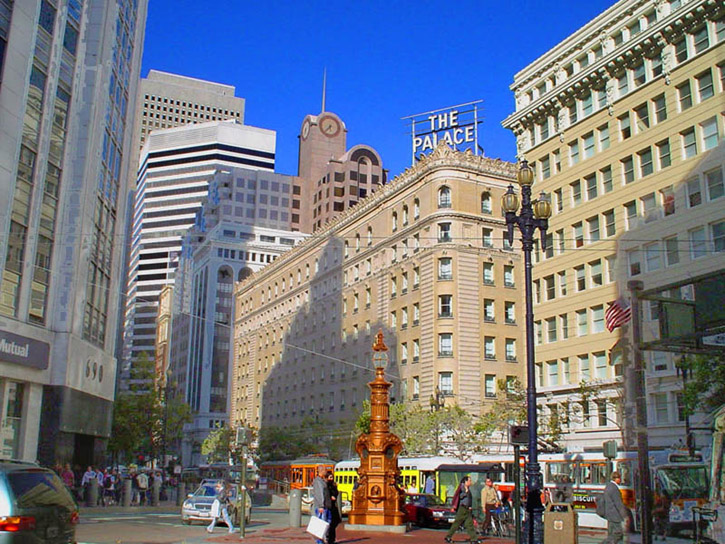
2003
With Lotta's
Fountain (foreground) and the Monadnock
Building (right)

1923
The
Ballroom

1923
The
Lobby
1925
The Lobby

1930
The
Lobby

2003
The
Lobby

1912
The Garden Court

1918
The Garden Court

1922
The Garden Court
1927
The Garden Court
1939
The Garden Court

1945
The Garden Court

1963
The Garden Court

2003
The
Palm Court

1909
"The
Pied Piper of Hamlin"
by Maxfield
Parrish
(6' x 16')

1935
Pied
Piper Bar

Exhibits courtesy of the
Bruce C. Cooper Collections.
Original text, annotations,
modern and composite images
by Bruce C. Cooper, DigitalImageServices.com.
Use of this
Web site permits personal use web viewing only; no copying;
arbitration; no
warranty.
This historical site is neither owned by
nor affiliated with, the The
Palace Hotel.
A mirror of this site is located on the Central
Pacific Railroad Photographic History Museum.
Also see:
Copyright © 2004-2018, CPRR.org. All
Rights Reserved. [Last updated 10/5/2018]
Use of this Web site constitutes acceptance of the User
Agreement;
Click any image or link to accept.
This CPRR Museum website is not affiliated with
the Palace Hotel.
HOME | City
Views of 19th Century San Francisco | Palace
Hotel | Huntington
Hotel | Other
San Francisco Hotels


